Go back
Execution infrastructure for finance systems
ERP- Cloud migration to Business Central: an exit date you can commit to
Six reasoning agents over a deterministic execution core. Every step hands off an artifact you can open and read, and nothing reaches the ledger until the trial balance holds.
ERP cloud migration to Business Central and Sage: an exit date you can commit to
ERP-to-ERP migration with a $0.00 balance gate
54 configured CFO workflows, agentic from day one
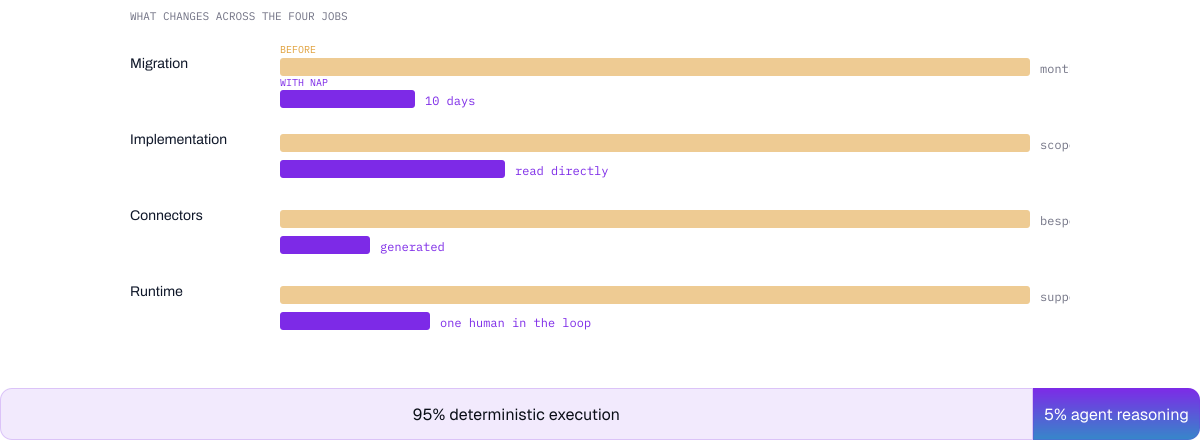
95% deterministic, every decision auditable
Conversational, built on your own knowledge base
Migration
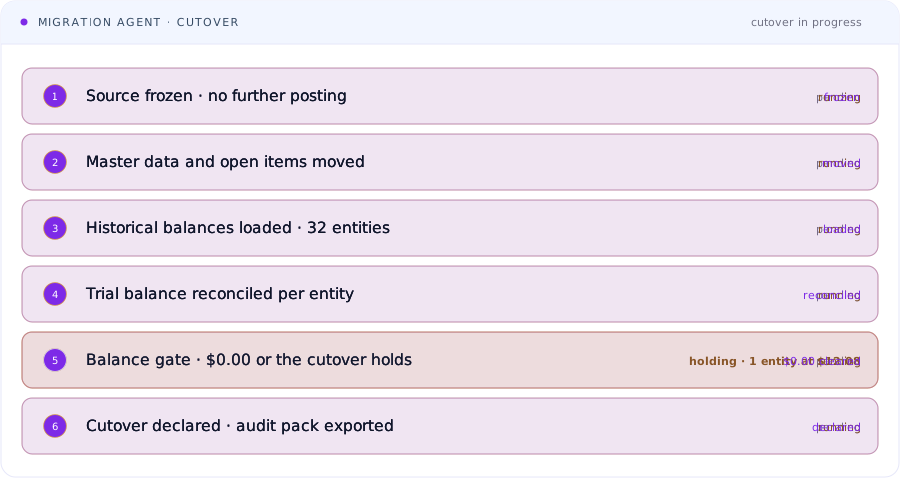
Cutover is declared against a balance, not a checklist.
The Guardmigration only
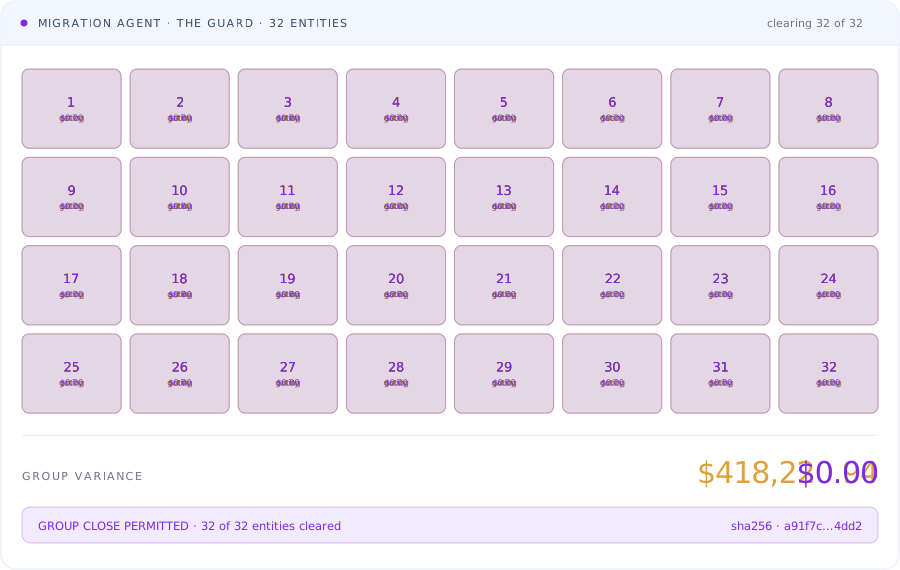
$0.00, or the cutover does not happen.
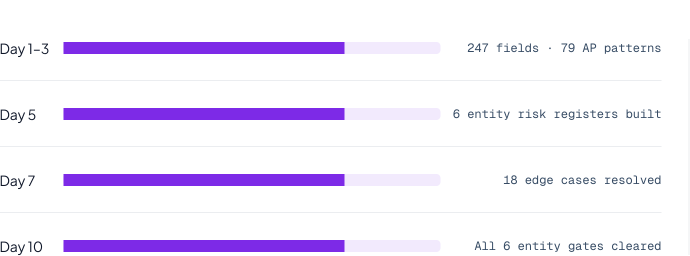
Open balances, historical transactions, and master data move under a trial-balance gate enforced at the database layer, not in application logic that can be bypassed.
Anything other than zero variance stops the transaction before it reaches the ledger. The migration cannot be declared complete against a variance somebody agreed to look at later.
Every check is hash-chained with SHA-256 and exports as an audit pack your client's auditors can read.
SHA-256
chained proof per check
DB layer
below the application
Audit pack
Audit pack
On-premise to cloud
Moving off a server is its own project.
Different trigger, different economics, different failure modes. Microsoft publishes a migration programme that answers most of the cost objection. Sage does not, but the hardware deadline does the same job.
See cloud migration
Systems we know
Four systems, and what
actually breaks in each.
Migration tooling is generic. The problems are not. What follows is the specific ground on each platform, which is the part that decides whether the first close in the new system ties.
Microsoft · leaving
Dynamics GP
Great Plains · on-premise · support ends 31 Dec 2029
What we work with
Dexterity
eConnect
Integration Manager
SmartConnect
Account framework
Analytical Accounting
SmartList
Fixed Assets
Company database per entity
  • Account framework segments resolved to dimensions from posted history, not from the setup screen.
  • Analytical Accounting codes carry meaning that never reached the account string. Extracted, not dropped.
  • One database per company becomes one environment with entity scoping. Vendor masters de-duplicated, divergent terms reconciled.
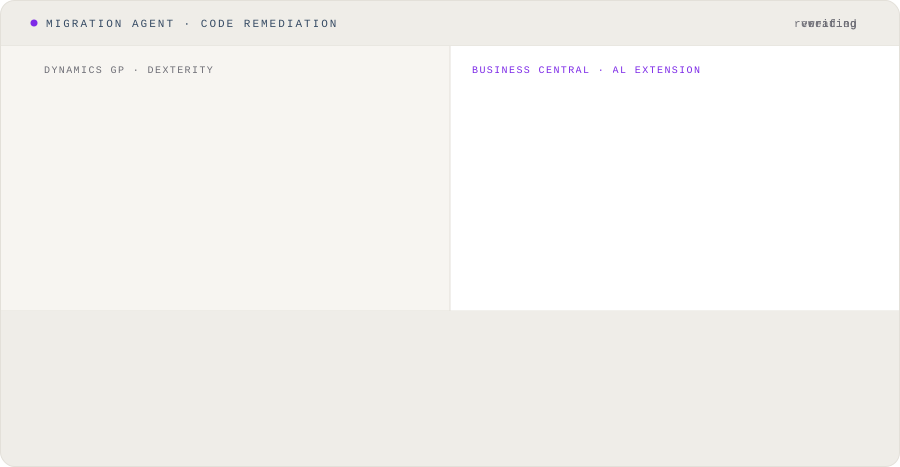
  • Dexterity customizations classified: rewritten as extensions, already native in the target, or written for a problem that no longer exists.
  • Fixed asset history and remaining life carried so the first period does not restate.
Microsoft's AIM programme can offset a material share of the implementation cost for customers moving off GP. We build the migration to qualify.
Microsoft · leaving
Dynamics NAV
Navision · final version 2017 · extended support ends Jan 2028
What we work with
C/AL
AL extensions
Dimensions
Object customizations
NAV 2013-2017
Web services
  • C/AL to AL conversion is the work. Heavily customized objects take months if approached by hand.
  • Dimensions already exist in NAV, which makes the account model easier and the customization surface harder.
  • Object-level customizations inventoried and classified before anything is rewritten.
  • Version fragmentation matters. Support windows differ by release and are often shorter than the headline date.
  • Fixed asset history and remaining life carried so the first period does not restate.
Also covered by the AIM programme for NAV customers moving to Business Central.
Microsoft · target
Dynamics 365 Business Central
the SMB landing point for GP, NAV and SL
What we work with
AL extensions
API v2.0
MCP
Agent Framework
OData
Global & Shortcut Dimensions
Dataverse
Power Platform
  • Dimensions replace segments. Global Dimension 1 and 2, plus shortcut dimensions for what the account string never carried.
  • Every integration rebuilt against the API surface. eConnect inserts become API calls with an idempotency key.
  • Direct database writes end. Spreadsheets writing into SQL get a journal API and lose the back door.
  • NAP agents run alongside Business Central's own agent framework rather than competing with it.
Sage
Sage 100, 200 and 300 → Sage Intacct
the cloud upgrade path
What we work with
Segmented GL
Visual Integrator
Intacct Web Services
BOI
ODBC
Job Cost
Optional fields
Dimensions
Books
  • Segments become dimensions Location, department, project, class and employee resolved from posted history.
  • Separate company files become entities under one consolidation, with ownership, currency and elimination rules restated.
  • Books separated properly. Accrual, cash and tax, rather than reconstructed from journal conventions carried over.
  • Job Cost becomes Projects. Optional and user-defined fields extracted rather than lost at cutover.
  • Statistical accounts moved so allocation logic runs on day one.
Microsoft · leaving
Dynamics GP
Great Plains · on-premise · support ends 31 Dec 2029
What we work with
Dexterity
eConnect
Integration Manager
SmartConnect
Account framework
Analytical Accounting
SmartList
Fixed Assets
Company database per entity
  • Account framework segments resolved to dimensions from posted history, not from the setup screen.
  • Analytical Accounting codes carry meaning that never reached the account string. Extracted, not dropped.
  • One database per company becomes one environment with entity scoping. Vendor masters de-duplicated, divergent terms reconciled.
  • Dexterity customizations classified: rewritten as extensions, already native in the target, or written for a problem that no longer exists.
  • Fixed asset history and remaining life carried so the first period does not restate.
Microsoft's AIM programme can offset a material share of the implementation cost for customers moving off GP. We build the migration to qualify.
Microsoft · leaving
Dynamics NAV
Navision · final version 2017 · extended support ends Jan 2028
What we work with
C/AL
AL extensions
Dimensions
Object customizations
NAV 2013-2017
Web services
  • C/AL to AL conversion is the work. Heavily customized objects take months if approached by hand.
  • Dimensions already exist in NAV, which makes the account model easier and the customization surface harder.
  • Object-level customizations inventoried and classified before anything is rewritten.
  • Version fragmentation matters. Support windows differ by release and are often shorter than the headline date.
  • Fixed asset history and remaining life carried so the first period does not restate.
Also covered by the AIM programme for NAV customers moving to Business Central.
Microsoft · target
Dynamics 365 Business Central
the SMB landing point for GP, NAV and SL
What we work with
AL extensions
API v2.0
MCP
Agent Framework
OData
Global & Shortcut Dimensions
Dataverse
Power Platform
  • Dimensions replace segments. Global Dimension 1 and 2, plus shortcut dimensions for what the account string never carried.
  • Every integration rebuilt against the API surface. eConnect inserts become API calls with an idempotency key.
  • Direct database writes end. Spreadsheets writing into SQL get a journal API and lose the back door.
  • NAP agents run alongside Business Central's own agent framework rather than competing with it.
Code and customization
Twenty years of custom code, read and rewritten.
Dexterity in GP. C/AL in NAV. Written for a business problem, by someone who left before the current controller was hired, and documented nowhere.
Behaviour preserved
Replayed against real payloads. If the new code does not behave the way the old code did, it does not ship.
Unsafe paths found
The retry that would have double-posted a payment is found and guarded before the first write, not after the first close.
Direct writes removed
Anything writing straight into the database gets an API path and loses the back door.
Most of it does not need to move.
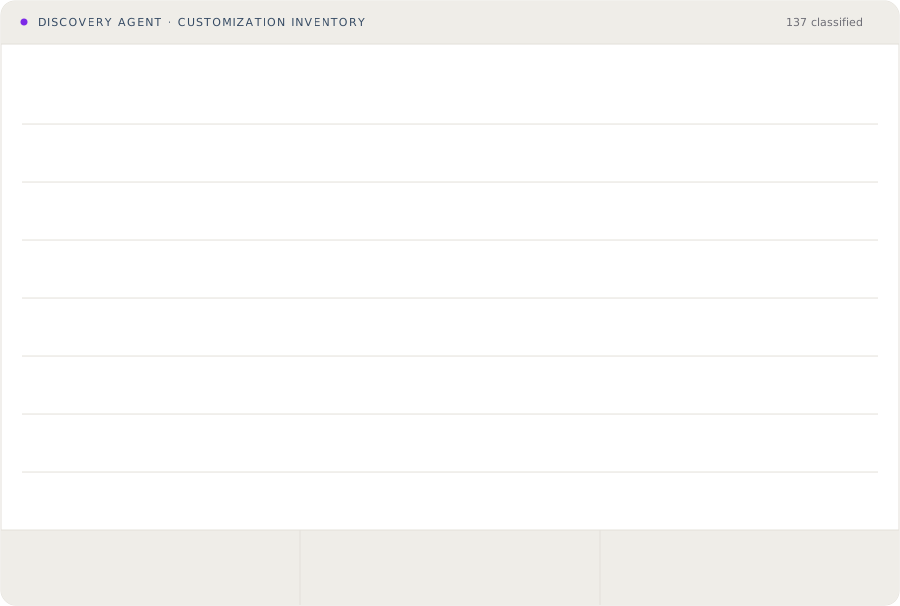
Every customization is catalogued and classified: carried forward, rewritten as an extension, or retired because the target does it natively or the problem no longer exists.
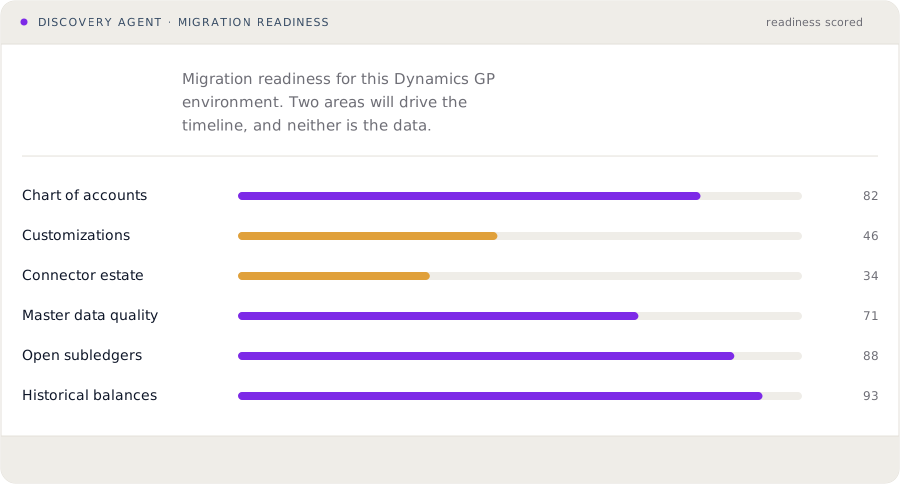
On a typical GP estate, nearly half is retired.

Architecture
Six agents that reason. Everything else runs the same way every time.
Intelligence activates at decision points. Everything else is deterministic execution that runs identically on every pass and logs every action.
Reasoning agents
Where judgment happens
01
Blueprint Builder
Turns intent into an execution plan. Systems, steps, branches, dependencies, risks.
02
Discovery
Reads the live environment before anything is written to it.
03
Mapping
Extracts undocumented objects and schema extensions, then maps them.
04
Proof Agent
Runs the build against real payloads and enforces the balance gate.
05
Production Support
Watches the running system and surfaces what needs a human.
06
Exception
Names the root cause, resolves it once, encodes it for everything after.
Deterministic execution
95% of every run
01
Rules applied as configured
Your policy, your entity logic, your approval matrix. Executed the same way every time.
02
Data shaped to the target
Transformation runs to the approved map. Nothing is inferred at runtime.
03
Steps sequenced correctly
Dependencies honoured, order enforced, retries guarded where an endpoint is not safe to repeat.
04
Writes committed in order
Across every system in the workflow, with the audit trail written as it goes.
05
Every result validated
Line variance, duplicate keys, reference integrity, and the balance gate before anything posts.
06
Configured workflows
Versioned and inspectable. You can read what will run before it runs.
Before you commit
Get your migration readiness scored.
We read the environment directly rather than sending a questionnaire. You get the chart of accounts assessment, the customization count, the connector estate, and where the timeline will actually go.
Get the readiness read