
USE Cases
Migrate, connect and run enterprise systems using AI agents.
Five ways to run enterprise finance operations. Every one works the same way: read what breaks, plan against prior deployments, execute across your systems, and keep what was learned.
Use cases
Pick the job. The method underneath is the same.
Different jobs, one execution layer. The difference between this and tooling is that software keeps what it learns.
use case 01
Build connector using human language
Describe the workflow and the agents build the connector, prove it, and run it. Prebuilt and deep across your ERP and enterprise systems, generated from nothing for anything else.
Prebuilt and deep across 29 ERPs and 15 enterprise systems
use case 02
Migrate enterprise systems using software and digital twins
The environment is read and modelled before anything moves. Open balances, history, and master data migrate under a $0.00 gate enforced at the database layer, and cutover is declared against a balance.
Cutover declared against $0.00 variance
use case 03
Map and transform data without writing rules
Undocumented fields, revenue schedules, 1099 treatment, and entity allocation resolved and shown to you for approval before anything posts.
Undocumented fields extracted and mapped
use case 04
Manage workflows and operations using AI agents
Agents that work an exception the way a person would. The root cause is named rather than the symptom, resolved once, and encoded so it does not come back.
Resolved once, then encoded permanently
use case 05
Talk to your integration stack
Ask why the AP batch stalled last night and get the answer, with the evidence. Build your own agents on the same layer, inheriting your entity hierarchy and vendor rules.
Built on the Forensic Library
Why partners use NAP
Talk to your stack. It answers.
72 pre-built workflows. AP automation, PO matching, vendor sync, and multi-entity consolidation — live the moment your ERP connects. Exceptions surface automatically. One click to approve. Your team decides, NAP executes.
THE SAME PROBLEM, BOTH TIMES
SOLUTIONS architecture
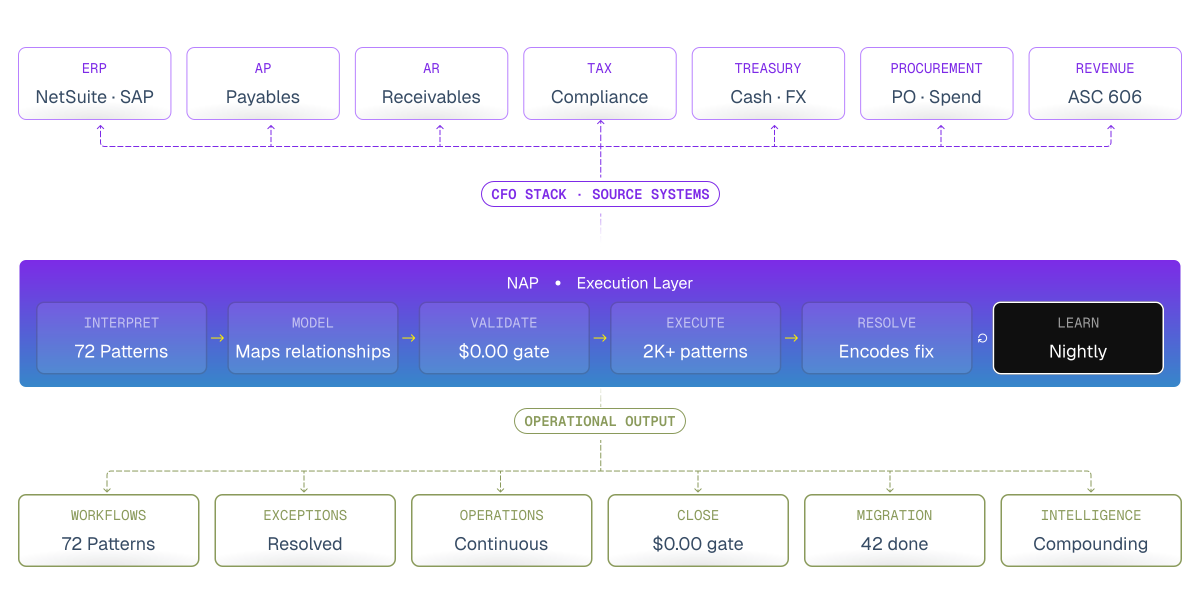
The execution layer between your stack and your operations.
72 pre-built workflows. AP automation, PO matching, vendor sync, and multi-entity consolidation — live the moment your ERP connects. Exceptions surface automatically. One click to approve. Your team decides, NAP executes.
THE SAME PROBLEM, BOTH TIMES
The method
One method. Every use case. The failure modes are what differ.
Read every block on this page the same way. The fourth column is the one that matters over time.
HOW EVERY DOMAIN IS READ
What breaks
What breaks
Blueprint reads
the signals
NAP executes
the action
What compounds
the rule kept
Step 01
What breaks
The failure as finance experiences it. Not an error code. A close that will not lock, a schedule that drifted, a vendor posting under the wrong entity.
Step 02
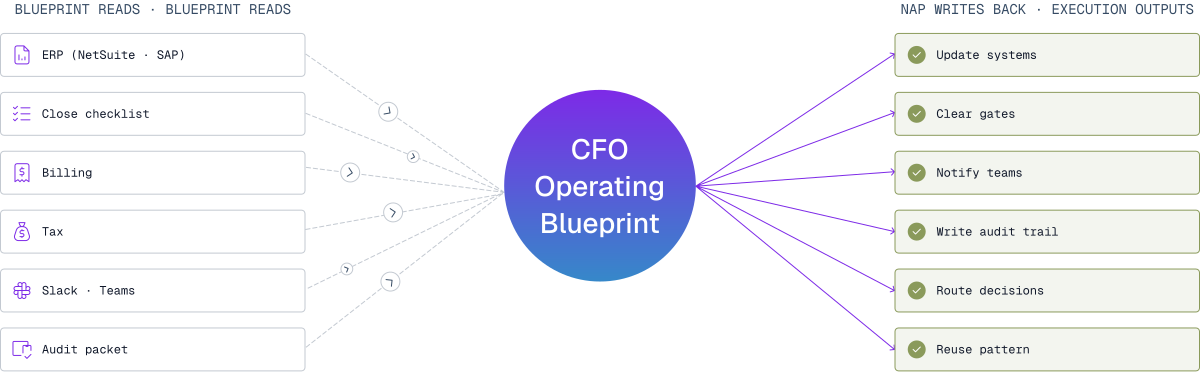
Blueprint reads
The signals NAP takes in. ERP, CRM, billing, tax, treasury, close, audit, documents, messages, and prior deployments.
step 03
NAP executes
The action taken across your systems. Gates cleared in sequence, journals posted, audit trail written, judgment routed to a person.
step 04
What compounds
What the system keeps. The rule is encoded and applied to every matching case afterwards, on this deployment and every one that follows.
The System
Connect
Run
Resolve
operate
Migrate
01 · The system

One continuous loop. Not six components.

Interprets, validates, executes, and learns — continuously, in production. 95% deterministic. Intelligence activates only where judgment is needed.

Blueprint Builder

Reads your ERP schema, generates the full execution architecture. 94.5% QA'd across 42 deployments. No intake docs. No discovery workshops.

Deterministic execution engine

95% of execution runs as deterministic code — governed, auditable, reproducible. Every action logged. Every decision traceable.

Nightly learning

Every execution feeds back overnight. Failure patterns encode automatically. Each deployment makes the next one faster.

02 · Connect

30+ enterprise systems. Connected and running.

2K+ failure modes across 30+ systems. Knows what breaks before the first record syncs. Bidirectional, auditable, self-monitoring from day one.

22 ERP systems covered

NetSuite, Sage, SAP, Oracle, Coupa, QuickBooks, Workday, and 15 more. Every connector pre-tested against common failure modes.

No two stacks behave the same

AP workflows vary by industry. 3-way match + bill-of-lading for manufacturing is fundamentally different from ASC 606 for SaaS. NAP encodes both.

Bidirectional, self-monitoring

Sync isn't one-time. The connection monitors itself, detects drift, and surfaces anomalies — across AP, AR, GL, Close, Tax, Treasury, Procurement, and Revenue.

03 · Run

Continuous execution. Active from day one.

Real deployments across 10 verticals. Not templates — learned patterns from 42 live environments. Runs continuously, improves every night.

Handle exceptions, not escalate.

Edge cases don't create tickets. Pattern identified, resolution applied, surfaced for approval if needed.

Self-monitoring in production

Every run observed. Drift, anomalies, and failures surface automatically. Detects what's starting to break before it does.

1 engineer · 42 deployments

276,000+ executions. One engineer. The system handles what would otherwise require a permanent team.

04 · Resolve

2K+ failure modes. All encoded.

Same failure modes, every deployment. NAP has seen them all — resolutions encoded before you start. Most finance automation runs while correctness quietly degrades. NAP ensures failures never repeat.

Resolution without escalation

Exception detected. Pattern identified, resolution applied, outcome encoded. Next time it appears — anywhere — it's handled automatically.

The forensic knowledge base

42 deployments. 10 verticals. 1,020+ blueprint questions. 2K+ failure modes. Every resolution improves every deployment that follows.

Nothing breaks immediately

Tracks correctness over time — detecting the slow fragmentation behind 3-week close delays and 1,200-invoice reconciliation backlogs.

05 · Operate

Talk to your Stack.

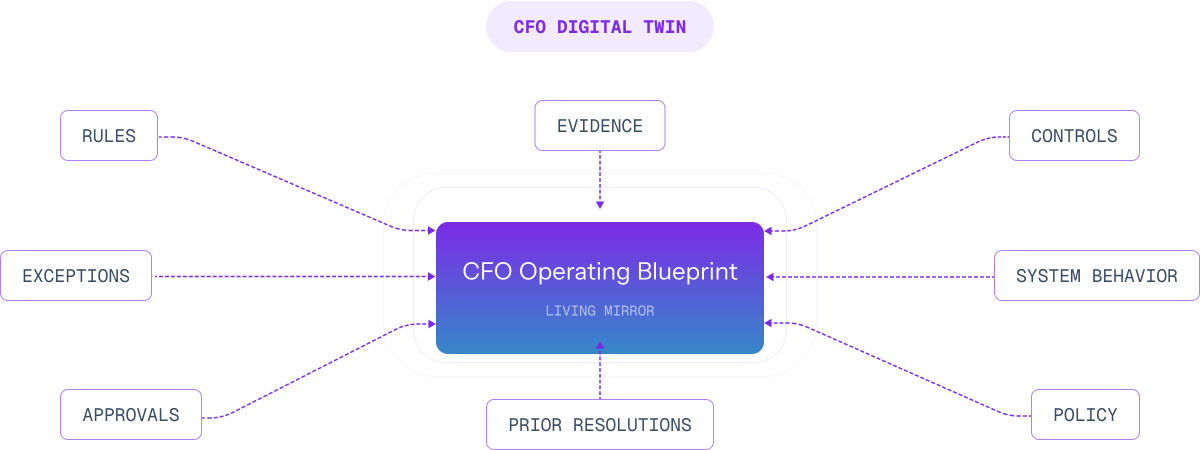
Built on your own forensic knowledge base — not generic AI. Knows your workflows, entities, and vendor rules. Surfaces issues. Fixes what breaks.

Grounded in your deployment

Grounded in your ERP configuration, entity hierarchy, and execution history. Knows the difference between how the system was designed and how it actually runs.

From question to action

"Fix the AP batch" is an instruction, not a question. The system resolves, encodes the pattern, and confirms. It won't happen again.

Always current

Knowledge base updates nightly. Every question answered against current system state — not a snapshot.

06 · Migrate

$0.00 balance gate. No override. Always.

ERP-to-ERP data migration. The system doesn't start from configuration — it starts from prior deployments. 87% of fields auto-resolve by migration 3. Nothing posts until every entity reconciles to $0.00 at database layer.

Intelligent field mapping

Mapping registry built across 42 migrations. 87% of fields auto-resolve by migration 3. Human review focuses on the 13% that genuinely requires judgment.

Full CFO stack — not just AP

Vendor master, AP/AR balances, GL (22+ periods), POs, ASC 606, and intercompany eliminations — all migrated with full validation.

The compounding speed

Migration 1: 4 weeks. Migration 3+: 2 weeks. At scale: days. Every migration makes the next faster.